
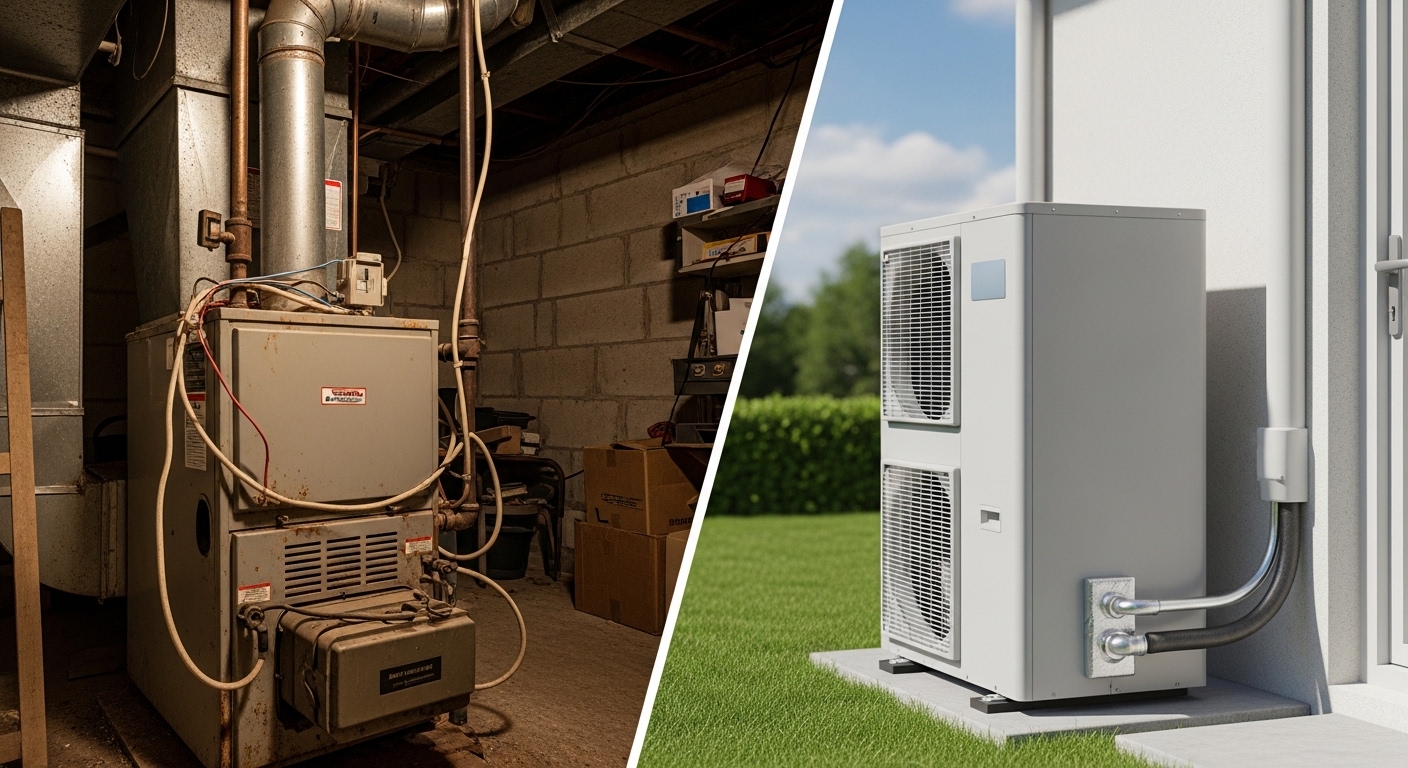
If your gas furnace is 10–20 years old, there’s a good chance it’s costing you more than it should, both in monthly utility bills and long-term maintenance. With energy prices rising and generous federal incentives now available, many homeowners are asking:
- How much does it cost to replace a gas furnace with a heat pump?
- Is switching from gas to electric worth it?
- What rebates are available for converting to a heat pump?
- Will a heat pump actually work in cold weather?
This guide breaks it all down clearly: the costs, savings, rebates, and what to expect during a gas furnace to heat pump conversion.
Why Homeowners Are Switching from Gas Furnaces to Heat Pumps
A traditional gas furnace creates heat by burning natural gas. A heat pump works differently, moving heat instead of generating it. That single difference is what makes heat pumps dramatically more energy-efficient.
When you convert from a gas furnace to a heat pump:
- You reduce reliance on fossil fuels
- You gain both heating and cooling in one system
- You often lower long-term energy costs
- You become eligible for substantial federal and state rebates
For many homeowners, especially those replacing both a furnace and an aging AC system, the switch makes financial and practical sense.
How Much Does It Cost to Replace a Gas Furnace with a Heat Pump?
Let’s talk numbers.
Typical Heat Pump Conversion Cost
For most homes, converting from a gas furnace to a heat pump system costs:
- $10,000–$18,000 for standard installations
- $18,000–$25,000+ for larger homes or homes requiring electrical upgrades
The final price depends on:
- Home size and heat pump tonnage
- Whether ductwork needs modification
- Electrical panel capacity
- Removal of the existing gas furnace
- Labor rates in your region
If your furnace and AC are both near the end of their lifespan, replacing them together with a heat pump often provides better long-term value than replacing them separately.
What Rebates Are Available for Gas-to-Heat Pump Conversion?
This is where things get interesting.
Under the Inflation Reduction Act (IRA), eligible households can access substantial rebates for electrification upgrades.
Federal Heat Pump Rebates May Include:
- Up to $8,000 for a qualifying heat pump HVAC system
- Up to $4,000 for an electrical panel upgrade
- Additional state or utility incentives depending on location
Eligibility is based on household income relative to Area Median Income (AMI):
- Under 80% AMI → may qualify for 100% rebate coverage
- 80–150% AMI → may qualify for 50% coverage
- Above 150% AMI → may qualify for federal tax credits and other incentives
Many homeowners are surprised to learn they may qualify for significant savings—even if they don’t qualify for full rebates.
MyNewHeatPump helps homeowners:
- Determine eligibility
- Stack federal + state + local incentives
- Connect with qualified contractors
- Navigate paperwork requirements
How Much Can You Save on Energy Bills?
One of the most common questions is: ‘Will a heat pump actually lower my energy bills?’
In many cases, yes.
Heat pumps are capable of delivering 2–3 units of heat energy for every unit of electricity used, making them far more efficient than gas systems in moderate climates.
Estimated Savings
While savings vary by region and fuel prices, homeowners often report:
- 20–40% reduction in heating costs
- Lower cooling costs compared to older AC units
- Reduced maintenance expenses over time
If your area has high natural gas prices or rising delivery fees, switching to electric heating can provide long-term stability.
What to Expect During a Gas Furnace to Heat Pump Conversion
Homeowners often worry that the conversion process will be disruptive or complicated. In reality, with the right installer, the process is straightforward.
Step 1: Home Evaluation & Load Calculation
A contractor performs a Manual J load calculation to determine proper system sizing. Oversizing or undersizing reduces efficiency and comfort.
Proper sizing is especially important for rebate compliance.
Step 2: Equipment Selection
Your installer will help determine:
- Standard vs. cold-climate heat pump
- Ducted vs. ductless options
- Whether to use a hybrid system (heat pump + backup furnace)
In colder regions, modern cold-climate heat pumps can operate efficiently even in sub-zero temperatures.
Step 3: Electrical Review
Some homes require:
- 200-amp electrical panel upgrades
- New dedicated circuits
- Minor wiring adjustments
These upgrades may also qualify for federal incentives.
Step 4: Removal of Gas Furnace
Your old furnace is disconnected and removed. Gas lines are safely capped according to code.
Step 5: Installation & Testing
The new heat pump system is installed, connected, calibrated, and tested for optimal performance.
Most installations take 1–3 days, depending on project complexity.
Will a Heat Pump Work in Cold Climates?
This is one of the biggest concerns.
Older heat pump models struggled in extreme cold. Modern cold-climate systems are different.
Today’s advanced models:
- Extract heat even at temperatures below 0°F
- Include variable-speed compressors
- Maintain stable indoor comfort
In very cold regions, some homeowners choose a dual-fuel system, where a furnace serves as backup during rare extreme temperature events.
Gas vs Heat Pump: Long-Term Comparison
| Feature | Gas Furnace | Heat Pump |
| Energy Source | Natural Gas | Electricity |
| Efficiency | 80–98% AFUE | 200–300%+ effective efficiency |
| Cooling Capability | Separate AC required | Built-in |
| Emissions | Burns fossil fuels | Lower emissions |
| Rebates Available | Limited | Significant federal/state incentives |
If you’re replacing both a furnace and AC, the heat pump often wins financially.
Is Converting from Gas to Electric Worth It?
For many homeowners, the answer is yes, especially when:
- Your furnace is 10+ years old
- Your AC also needs replacement
- You qualify for rebates
- You want lower long-term energy costs
- You’re looking to reduce carbon emissions
The key is running the numbers for your specific home and location.
The Bottom Line: Is Now the Right Time To Switch?
With federal rebates available and energy costs continuing to fluctuate, many homeowners find that now is the most financially advantageous time to convert from a gas furnace to a heat pump.
You gain:
- Year-round comfort in one system
- Access to substantial rebates
- Lower energy consumption
- A more future-ready home
The smartest next step is understanding what your home qualifies for.
MyNewHeatPump.com connects homeowners with certified installers and helps maximize every available rebate, so you can upgrade confidently, without navigating the paperwork alone.
Ready to see how much you could save? Check your eligibility and explore your options today.
Check Your Eligibility for State & Federal Rebates Today at MyNewHeatPump.com!
Upgrading from a gas furnace to a heat pump doesn’t have to feel overwhelming. Find out how much you could save with federal and state rebates in just a few minutes.
Check your eligibility today and take the first step toward lower energy bills and year-round comfort.